Understanding Jerusalem’s Place on the Map
This guide covers everything about where’s jerusalem israel located. Many people wonder: where’s Jerusalem, Israel located? This ancient city holds immense religious and historical importance for Judaism, Christianity, and Islam, making its geographical context Key. Situated in the Middle East, Jerusalem is perched on a plateau in the Judean Mountains, about 760 meters (2,490 feet) above sea level. It’s not directly on the Mediterranean coast, nor is it located in the desert expanses of the Negev. Instead, its position is central to the land of Israel, straddling the watershed between the Mediterranean Sea to the west and the Jordan Rift Valley to the east.
Last updated: April 22, 2026
The Geographic Heart of the Region
Jerusalem’s location is central not only within Israel but also within the broader region often referred to as the Holy Land. it’s positioned approximately 60 kilometers (37 miles) east of Tel Aviv and the Mediterranean coast. The Dead Sea lies about 30 kilometers (19 miles) to the east. This strategic placement has influenced its history, making it a crossroads for trade routes and a focal point for empires and peoples throughout millennia. The city’s elevation contributes to its temperate climate, with distinct seasons.
Navigating Jerusalem’s Administrative and Political Context
The administrative and political geography of Jerusalem is complex and a subject of ongoing international debate. Israel considers Jerusalem its undivided capital, with its Knesset (parliament) and Supreme Court located within the city. However, this status isn’t universally recognized by the international community. Many countries maintain their embassies in Tel Aviv, reflecting the dispute over the city’s final status, especially concerning East Jerusalem — which Israel captured and annexed in 1967.
According to the United Nations, East Jerusalem is considered occupied Palestinian territory. This division influences the city’s infrastructure, governance, and daily life for its residents. Understanding this context is essential when discussing Jerusalem’s location, as it extends beyond purely geographical coordinates to encompass political realities.
Key Geographic Features and Landmarks
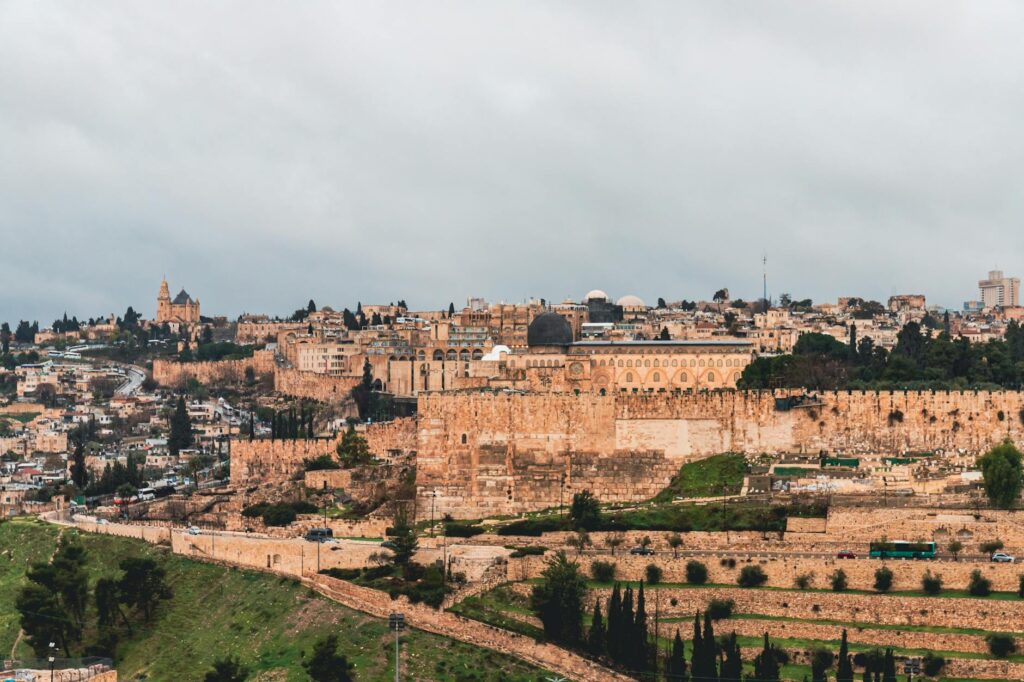
Jerusalem is defined by its topography. The city is built on several hills, most notably Mount Zion, the Mount of Olives, and Mount Scopus. The Old City, the historical and spiritual heart, is enclosed by ancient walls and is divided into four quarters: the Jewish, Christian, Muslim, and Armenian Quarters. Each quarter contains sites of profound significance.
Prominent landmarks are deeply tied to the landscape. The Western Wall, a remnant of the ancient Jewish Temple, is situated at the foot of the Western Hill. The Dome of the Rock and Al-Aqsa Mosque, sacred to Muslims, are located on the Temple Mount (known to Muslims as Haram al-Sharif), the highest point within the Old City. The Kidron Valley separates the Old City from the Mount of Olives, a site with numerous ancient Jewish burial caves and significant Christian holy places.
Climate and its Influence
Jerusalem experiences a Mediterranean climate with hot, dry summers and cool, wet winters. Average high temperatures in July and August can reach around 30°C (86°F), while winter lows in January can dip to around 7°C (45°F). Rainfall is concentrated between November and March. The city receives an average of about 550 millimeters (22 inches) of precipitation annually. This climate supports agriculture in the surrounding hills, historically including olive groves and vineyards.
The elevation plays a significant role in moderating temperatures compared to coastal cities like Tel Aviv. Snowfall, while not common, can occur during the winter months. This climate has shaped the architecture of the city, with many buildings constructed from local limestone that gives Jerusalem its distinctive golden hue.
Accessibility and Transportation
Getting to Jerusalem is straightforward, although its inland location means it doesn’t have a coastal port or direct access to a major international airport within its immediate vicinity. Ben Gurion Airport (TLV), Israel’s main international gateway, is located near Tel Aviv, about a 45-minute to one-hour drive from Jerusalem. According to the Israel Airports Authority, Ben Gurion Airport handled over 24 million passengers in 2023, underscoring its role as the primary entry point for international visitors.
From the airport and major Israeli cities, a modern highway system connects to Jerusalem. Public transportation includes buses and a light rail system within the city. The light rail — which began operation in 2011, serves key routes and has improved intra-city travel. The historical railway line connecting Jerusalem to Tel Aviv has also been revived as a high-speed train, reducing travel time significantly.
Historical Significance Tied to Location
Jerusalem’s location has been a magnet for pilgrims, conquerors, and rulers for thousands of years. Its position on a defensible hilltop, with access to water sources, made it an attractive settlement site. As the ancient capital of the Kingdom of Judah, and later the site of two Jewish Temples, its religious significance solidified early on. Later, its association with the life of Jesus made it central to Christianity, and its connection to the Prophet Muhammad made it a holy city for Islam.
The city has been conquered, destroyed, and rebuilt numerous times. Major historical events tied to its location include the Babylonian conquest in 586 BCE, the Roman destruction in 70 CE, the Crusades, and the Ottoman and British Mandate periods. Each era left its mark on the city’s physical and cultural landscape, all influenced by its strategic and sacred positioning.
Practical Tips for Visitors
When planning a visit, remember that Jerusalem is situated inland. Pack layers of clothing, as temperatures can vary throughout the day and between seasons. Comfortable walking shoes are essential, especially for uneven terrain of the Old City. Be aware of the diverse religious and cultural sensitivities within the city. respectful attire is advised when visiting holy sites.
Transportation within the city is relatively easy. The light rail is efficient for reaching many modern areas, while taxis and walking are best for the Old City. Consider purchasing a Rav-Kav card for easy payment on public transport. For those interested in the historical and religious aspects, guided tours can offer deep insights into the city’s complex past and present.
Frequently Asked Questions
Is Jerusalem in the West Bank?
While Jerusalem is geographically located in the mountainous region of Israel, its eastern part, East Jerusalem, is considered occupied Palestinian territory by most of the international community. Israel considers the entire city its capital. The status of Jerusalem remains a central issue in the Israeli-Palestinian conflict.
what’s the elevation of Jerusalem?
Jerusalem sits on a plateau in the Judean Mountains at an average elevation of approximately 760 meters (2,490 feet) above sea level. This high elevation contributes to its distinct climate compared to Israel’s coastal regions.
How far is Jerusalem from Tel Aviv?
Jerusalem is located about 60 kilometers (37 miles) east of Tel Aviv. The journey by car or the high-speed train typically takes between 45 minutes to an hour, depending on traffic and mode of transport.
What countries border Jerusalem?
Jerusalem is an inland city and doesn’t directly border any countries. it’s located within Israel. Its closest major city is Tel Aviv to the west, and the Dead Sea lies to its east.
Why is Jerusalem’s location so significant?
Its location is significant due to its status as a holy city for Judaism, Christianity, and Islam, its historical role as a capital city, and its strategic position at the crossroads of ancient trade routes in the Middle East. This has led to millennia of historical events and cultural exchange.
Concluding Thoughts on Jerusalem’s Place
In summary, Jerusalem, Israel, is geographically situated in the Judean Mountains of the Middle East, roughly 60 km east of the Mediterranean coast. Its high elevation and central position have profoundly shaped its destiny. Understanding this location is vital for anyone seeking to grasp the historical, religious, and political dimensions of this remarkable city. Whether you’re a pilgrim, a historian, or a curious traveler, Jerusalem’s unique geography is an integral part of its captivating story.
Source: Britannica
Related Articles
- where’s Barbados? Beyond the Beaches
- Lauren Sanchez Plastic Surgery: What Analysis Reveals
- Bella Murphy: Unpacking Her Impact in 2026
Editorial Note: This article was researched and written by the Higher Intentions editorial team. We fact-check our content and update it regularly. For questions or corrections, contact us.